
From Narendranath to Swami Vivekananda: A Journey of Self-Realization

Full Name: Narendranath Datta
Born: January 12, 1863, in Kolkata, Bengal Presidency, British India
Died: July 4, 1902, in Belur Math, West Bengal, India
Occupation: Philosopher, Monk, Spiritual Leader, Social Reformer
Famous for: Reviving Hinduism, Inspirational Speech at the 1893 Parliament of World’s Religions in Chicago
Swami Vivekananda was a great spiritual leader, philosopher, and thinker who played a pivotal role in the resurgence of Hinduism in India and across the globe. His ideas of unity, self-realization, and service to humanity continue to inspire people worldwide. He is best known for his speech at the 1893 Parliament of the World's Religions in Chicago, where his opening words, "Sisters and Brothers of America," resonated with audiences and catapulted him to international fame.
Early Life and Spiritual Quest
Swami Vivekananda was born as Narendranath Datta on January 12, 1863, in a well-to-do Bengali family in Kolkata (then Calcutta). His father, Vishwanath Datta, was an attorney, and his mother, Bhuvaneshwari Devi, was a deeply religious woman. From an early age, Narendranath exhibited an extraordinary intellect and curiosity about the world, which later defined his spiritual journey.
He was highly influenced by his mother’s spiritual devotion and his father’s rational thinking. Narendranath was exposed to a variety of religious teachings, including Hinduism, Christianity, and Western philosophy, but he had deep questions about life and spirituality. As a young man, he joined the Brahmo Samaj, a reformist religious movement in Bengal, but found it intellectually satisfying yet spiritually incomplete.
Meeting Ramakrishna Paramahamsa
The turning point in Narendranath's life came when he met Ramakrishna Paramahamsa, a mystic and saint who became his spiritual guru. Initially skeptical of Ramakrishna’s teachings, Narendranath asked him a profound question: “Have you seen God?” Ramakrishna answered simply, “Yes, I see Him just as I see you.” This experience marked the beginning of Narendranath’s transformation into Swami Vivekananda.
Ramakrishna’s teachings about the oneness of all religions, the divinity of man, and the realization of God within oneself deeply resonated with Narendranath. After Ramakrishna's death in 1886, Narendranath and his fellow disciples renounced worldly life and became monks, taking vows of renunciation. It was during this time that Narendranath became Swami Vivekananda.
The Birth of Swami Vivekananda
Swami Vivekananda spent the following years traveling across India, witnessing the poverty, suffering, and ignorance that plagued the country. He was deeply moved by the condition of the masses and sought a way to lift them out of misery, not only spiritually but also socially and economically.
In 1893, with the goal of representing India's spiritual heritage on the world stage, Swami Vivekananda traveled to the United States to attend the Parliament of the World's Religions in Chicago. His speech, delivered on September 11, 1893, introduced Hinduism to the Western world. Vivekananda spoke about religious tolerance, the unity of all faiths, and the need for spiritual realization beyond dogma. His opening words—“Sisters and Brothers of America”—received a standing ovation and left a lasting impression.
Vivekananda's Message to the World
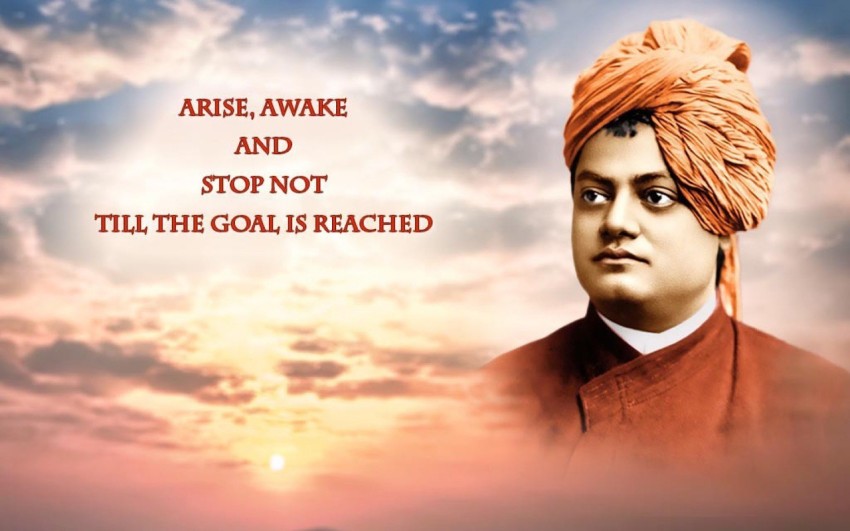
Swami Vivekananda's message was simple yet profound: every human being has the potential to realize the divine within themselves. He emphasized the importance of self-realization, service to humanity, and the idea that all religions lead to the same truth.
Some of his key teachings include:
- The Divinity of the Soul: Vivekananda taught that every soul is divine and the goal of life is to realize this divinity within.
- Unity of All Religions: He believed that all religions are different paths leading to the same truth and should be respected equally.
- Service to Humanity: Swami Vivekananda stressed the importance of serving the poor and downtrodden, believing that serving humanity is equivalent to serving God.
- Strength and Self-Confidence: One of his famous quotes, “Arise, awake, and stop not till the goal is reached,” encapsulates his belief in self-confidence, strength, and perseverance in pursuing life’s goals.
Ramakrishna Mission
.jpg)
In 1897, after returning to India, Swami Vivekananda established the Ramakrishna Mission to carry forward the teachings of his guru and to serve humanity. The mission is dedicated to education, social reform, and humanitarian work, including providing healthcare, relief during natural disasters, and uplifting the poor.
The Ramakrishna Order became one of the most influential spiritual organizations in India, focusing on the practical application of spiritual teachings through service to society. Swami Vivekananda believed that spirituality and social work should go hand in hand, and this vision was carried forward through the mission's various activities.
Philosophy and Influence
Swami Vivekananda's philosophy was rooted in Vedanta, the ancient Indian philosophy that emphasizes the oneness of all existence and the divine nature of every individual. He brought this timeless wisdom to the modern world, adapting it to the needs of a rapidly changing society.
His teachings had a profound influence not only on Indian society but also on Western intellectuals and thinkers. He inspired many freedom fighters, including Mahatma Gandhi, who said that Vivekananda’s teachings taught him to love and serve the country. Subhas Chandra Bose, another prominent leader of India's independence movement, called him "the maker of modern India."
In the West, Swami Vivekananda’s teachings influenced major thinkers like Nikola Tesla, William James, and Aldous Huxley, bridging the gap between Eastern and Western philosophical traditions.
Death and Legacy
Swami Vivekananda passed away on July 4, 1902, at the young age of 39, but his impact has endured for more than a century. He died at the Belur Math, the headquarters of the Ramakrishna Mission, leaving behind a legacy of spiritual, intellectual, and social reform.
Swami Vivekananda’s birth anniversary, January 12, is celebrated as National Youth Day in India, in recognition of his profound influence on the youth and his belief that the youth were the key to the nation’s future.
His message of self-reliance, universal tolerance, and service to humanity continues to inspire millions around the world. His famous quote, “You have to grow from the inside out. None can teach you, none can make you spiritual. There is no other teacher but your own soul,” serves as a reminder of the power within each individual to achieve greatness.
Key Lessons from Swami Vivekananda’s Life
- Believe in Yourself: Vivekananda emphasized self-confidence and inner strength. His life was a testament to overcoming doubts and challenges to achieve one's true potential.
- Serve Others: He believed that service to humanity is the highest form of worship and that one should use their talents and resources to help the less fortunate.
- Spiritual Growth: Swami Vivekananda preached that self-realization and spiritual growth are the ultimate goals of life.
- Unity of Religions: He taught that all religions, at their core, lead to the same truth, and therefore, humanity must embrace religious tolerance and harmony.

